
http://img.dailymail.co.uk/i/pix/2007/01/china_468x312.jpg
20080226

Toward good form in landscape
Landscape for Living
Garret Eckbo
Theory - analyzing the past in the present toward the future.
Theory is not developed for its own sake. It must come from practical necessity.
Every work of landscape design produces arrangements of forms, colors and textures in space, which results in some sort of cumulative effect, good or bad, on those who pass through it.
The goodness or badness is not based on a theory of a particular school, but rather on certain questions of the arrangements of spaces, the development of sites, the use of materials, unity and variety, scale and proportion, rhythm and repetition.
There is no rigid central dogma. Our theory must be oriented within the social, as well as the technical and aesthetic, potential of the times.
Design, like life, has no limits to its development.


Land and ownership
J.B. Jackson
The Vernacular Landscape
Eco-friendly from the start?
No natural elements in the landscape could be owned or controlled by an individual. No one could control or exploit fire, water, earth or air.
Absence of permanent fences. The meadow, the forest, the field shared by all villagers. There even seems to have been an effort to enlarge these natural spaces in the landscape.
The right to use these resources derives from membership in a family/community: a web of interpersonal relationships produces and preserves the vernacular landscape, not a direct relationship with the environment itself.
The two kinds of wealth:
- movable property (not identified with any particular place)
- land (a visible, permanent sign of membership in a community)
The medieval triad of spaces:
- woodland
- grazing
- pasture
"Political" vs "vernacular"
 The distinction was more clear in the past.
aristocratic or political landscape - that of the crown and the nobility; ignores topography in favour of strategic or economic strong points; a creation of legal decisions and competition for power and land; relatively permanent spatial organization
vernacular landscape - that of the village or rural community; includes a small territory essential to its survival; its history is without (recorded) events; the unwritten sources - fairy tales, figures of speech, superstitions etc.
The Vernacular Landscape
J.B. Jackson
photos: http://www.ippnw-students.org/baltic/route.html ; pildistoop
The meaning of LANDSCAPE - a linguistic approach
The Vernacular landscape
J.B. Jackson
"LAND" + "SCAPE"
"land" - a defined space, a space with boundaries
"scape" - a composition of similar objects; an organisation or a system
"landscape" could have meant a system of rural farm spaces. It is a system created by man. A thousand years ago the word had nothing to do with scenery or the depiction of scenery.
It is a synthetic space, a man-made system functioning and evolving not according to natural laws but to serve a community.
A landscape is thus a space deliberately created to speed up or slow down the process of nature. As Eliade expresses it, it represents man taking upon himself the role of time.
"landscape" and "country" both indicate a tract of land seen at a glance; neither had any legal standing -> associated with peasantry; with no written history.
20080225
Place names and ideology
Place names hierarchize and semantically order the surface of the city.
Raekoja Square -> Hitler Square -> Soviet Square -> Raekoja Square
Wandersmänner

"The ordinary practitioners of the city live 'down below', below the thresholds at which visibility begins. They walk - an elementary form of this experience of the city; they are walkers, Wandersmänner, whose bodies follow the thicks and thins of an urban 'text' they write without being able to read it."
"Their story begins on ground level, with footsteps. They are myriad, but do not compose a series. They cannot be counted because each unit has a qualitative character. [...] Their swarming mass is an innumberble collection of singularities. Their interwined paths give their shape to spaces. They weave places together. [...] They are not localized; it is rather they that spatialize.
Michel de Certeau "Walking in the City"
Photo: Air Milkay
Concept-City

- urbanistic ratio
- atopia-utopia of optical knowledge
- synchronic system
- univocal scientific strategies
- the creation of universal and anonymous subject
- networks of order
- rationalization
- functionalist organisation
- progress
- scientific and political technology
keywords from Michel de Certeau's "Walking in the City"
NY

"New York has never learned the art of growing old by playing on all its pasts. Its present invents itself, from hour to hour, in the act of throwing away its previous accomplishments and challenging the future."
"The desire to see the city preceded the means of satisfying it. Medieval or Reneaissance painters represented the city as seen in a prespective that no eye yet enjoyed. This fiction already made the medieval spectator into a celestial eye. It created gods. Have things changed since technical procedures have organized an 'all seeing power'?"
"It's hard to be down, when you're up."
Michel de Certeau "Walking in the City"
Photo: Nicoatridge
20080222
Syntax of Landscape
"The site itself and ecological programs are forming the spaces of the future.
Considering we understand avant-garde landscape architecture as a translation of abstract ideas, ideas of nature, ecology and society. Then it seems very likely to understand design as an “invention” of information layers which overlap with existing systems, before we can think of shape or expression at all.
The semantic level is reserved for the viewers and users. The image comes about in the viewer’s head. How do we know that the experiences are in fact the ‘visual’ ones we assume, and not acoustic delights or the enjoyment of smells, warmth or cold instead – that space means only or mainly possibility for experiences?"
Challenge of the traditional
http://www.pwpla.com/
Peter Walker and Partners (PWP)
Exploring the relationship between art and culture, PWP challenges traditional concepts of design. Their work results from knowledge of history and tradition, sympathy with contemporary needs, understanding of both conceptual and material processes, mastery of construction, and attention to detail.
Seeking the in-between
http://www.hargreaves.com/
firm´s philosophy:
Hargreaves Associates has at its core a single overriding concern: connection -- connection between culture and the environment, connection between the land and its people.
Our work acknowledges the simple truth that 'made' landscapes can never be natural. With increasing frequency our work deals with land which has been made and re-made.
Through manipulation and amplification of environmental phenomena such as light, shadow, water, wind; residual environmental and industrial remnants; and topography and habitat, we strive to foster an awareness and understanding of the structural components of natural systems by direct interaction.
This direct interaction is in contrast to the insular experience of a replication or restoration of 'nature.' In this way the experience of these built landscapes may indeed be more real in their impact on people than landscapes of preservation or re-creation.
In other instances, these landscapes may accentuate past, present and future fusions of culture and environment. Whether reductive or rich, highly programmed or passive, culturally interpretive or teeming with the phenomena of nature's own systems, these built landscapes seek the power of connection to our day-to-day lives.
Martha Schwartz Partners
http://www.marthaschwartz.com/
MSP's philosophy recognizes that we, as a world community, now generally live within built environments; therefore, the quality of the design of these built environments affects, in large part, the quality of our existence. Additionally, as we see ourselves as part of "nature," aesthetics are a necessary component of environmentalism. The aesthetic quality, or design, of our environments will determine their success and relevance to our respective cultures.
At MSP, our designs synthesize complex social issues with the requirements of environmentally sound practice; however, in keeping with our office's design philosophy, we also bring a strong aesthetic focus to each project. While knowing that every project must be solved at an ecological level, MSP goes beyond each site's technical requirements to search for aesthetic solutions that in turn create value, a sense of identity, and determine the sustainability of a landscape.
Ateljee Süd - philosophy
http://www.ateljeesud.ee
"Architecture that doesn’t express serenity is a mistake"
-Ferdinand Bac, French writer and artist, 1859-1952
-Ferdinand Bac, French writer and artist, 1859-1952
27,525

"Welcome to Houseplans.com® the largest online collection featuring 27,525 plans. Search by design features and explore our collections and architectural styles. We can customize any house plan and our Instant Cost-to-Build Reports can help you budget your home building project. Our website is easy to use with lots of house building resources."
A life less ordinary
 Toronto Lofts
Toronto is a great city that is developing wonderful alternative living space in urban locations in the heart of the city. These wonderful Toronto lofts are close to great restaurants, shopping, theatres and parks with easy access to public transit, highway access, and central work areas.
Lofts give you open concept living, often with raw space that you can configure to your design preferences. But don't expect that this translates to low prices - it doesn't! The demand for these living spaces has pushed up the prices, which are on par with condos.
A life less ordinary. Where Art, technology, communications, and night life co-habitate. Queen Street West, Chinatown, King West Village to Harbourfront.
Hip. Vibrant. Alive.
Heritage. Transformation. Metropolis.
Choices
There are 2 Types of Lofts Conversions-Originally constructed as factories, warehouses, offices, or even Churches that have been transformed into living space offering either a "woodsy" warm interior of wood ceilings, wood floors, wood beams , or "concrete" edgier in feeling with concrete elements of fluted columns, concrete walls , and concrete floors. New Construction - Modern Urban Loft spaces that often borrow from the past in concept and space but project a clean futuristic design.http://www.loftsintoronto.com/loftdirectory.htm
There goes the neighborhood


"The Hitchhiker’s Guide to the Galaxy"
Bypasses are devices that allow some people to dash from point A to point B very fast while other people dash from point B to point A very fast. People living at point C, being a point directly in between, are often given to wonder what’s so great about point A that so many people from point B are so keen to get there, and what’s so great about point B that so many people from point A are so keen to get there. They often wish that people would just once and for all work out where the hell they wanted to be.
source: http://anize.org/nick/books_movies/
http://www.lawrimoreproject.com/suttonberesculler.html


20080221
Silent disco


The concept of a silent party or silent disco involves party-goers dancing to music received directly into headphones. Most commonly, this will be music provided by a DJ who will broadcast via an FM transmitter with the signal being picked up by wireless headphone receivers worn by the silent party attendees. Another type of silent party involves the gathering of a group of people in an unconventional location to dance to music which they provide themselves via an MP3 player and conventional wired headphones.
The idea has been around since the 1990s espoused by eco-activists who found that the easiest way to get large numbers of people to certain areas such as a forest that was being logged was to be put on a party, but this can cause distress to animals that are living in the area, so a compromise solution was needed for particularly sensitive areas.
Since then the concept has evolved into the guerilla-type gatherings as seen at London's Victoria Station in 2005 and also into commercial ventures across the UK, Europe and worldwide.
Source: Wikipedia.
The First Silent Disco in Estonia took place in February 2008 in NO-theater. Not the flash mob action exactly, but the FIRST event of this kind here :p


20080220
When Dostojevski meets Batman


Brian Hughes "Batman by Dostoyevsky"
http://againwiththecomics.blogspot.com/2007/08/batman-by-dostoyevsky.html
Gender issues and literature
Who has privilege to decide which kind of literature is considered pop and which is high? And why should some people feel that they have that privilege?
Some literary critics said that when a work was produced only to follow what public wanted to read—just for fun or entertainment, no “deep meaning” under the surface of the story—then it would be categorized into “pop literature”. In addition to that, people also said the work was only for commercial’s need, because the writer needed money when writing. On the contrary, when a work was produced not only to follow public’s needs, it was written more to fulfill the writer’s ambition to communicate “something important” to readers, so that the work had “deep meaning”, then the work could be categorized into “high-brow literature”.
The publication of THE NORTON ANTHOLOGY OF LITERATURE BY WOMEN can be considered one way of women’s struggle to include women’s works into high-brow literature. In the ‘preface’ of its first edition published in 1985, Sandra M. Gilbert and Susan Gubar wrote:
“… no single anthology has represented the exuberant variety yet strong continuity of the literature that English speaking women have produced between the fourteenth century and the present. In the NORTON ANTHOLOGY OF LITERATURE BY WOMEN, we are attempting to do just that.”
Furthermore, in the sixth edition of The Norton Anthology of American Literature appearing in the beginning of the twenty first century, Nina Baym, the general editor, stated in the preface:
“That the “untraditional” authors listed above have now become part of the American literary canon shows that canons are not fixed, but emerge and change.”
It can be included that in the long run dichotomy of pop and high literature will disappear peacefully. It is up to public to value and to choose which works they will read. I am of opinion that in society where people are mature enough to choose which works to read, bad writings will be left behind.
from: A Feminist blog "High Literature vs Popular Literature"
http://afeministblog.blogspot.com/2007/09/high-literature-vs-popular-literature.html
The binary halves
There are things accused of as being pedantic, high-brow. There are things accused of being uncultured, low-brow. These criticisms are aimed at each side by the other, a perpetual war of who is most right and righteous.
This is the rift between the sides of one of the many binaries that our society thrives on. Accurate or not, these ideas exist in the minds of most as stereotypes and identities. That’s what a binary is, really—cultural assumptions roots in gross generalizations for the sake of pigeon-holing at best, oppressing at worst.
On one side of the binary we have the so-called “cultural elite,” the educated, the worldly, the appreciator of the finer things in life, the classy; the elitist, the sheltered, the snobby, the posh, the removed-from-reality, the useless-to-society.
One the other side we have the so-called “average citizen,” the masses, middle America, the contributors to general society, the street-smart, the reality-based; the uneducated, consumeristic-without-question, the classless, the TV-watching, the fast-food-eating.
from: "Highbrow vs Lowbrow" by Vee
http://veethemonsoon.wordpress.com/
All about good taste

 campana brother's blow up table Designed by Campana Brothers
The Campana Brothers are once again out to change the domestic landscape, sometimes almost too rooted in their form/function ratio. The Blow Up series of items are random and chaotic, reminiscent of the forms of recycling typical of urban conglomerates in the third world, or at least as many Europeans and Americans might imagine them, but this is done poetically, skillfully respecting the basic requirements of the relevant objects.
Small table in 18/10 stainless steel mirror polished and glass.
http://www.highbrowfurniture.com/tables/products/blowup2/
Identity question - highbrow or lowbrow?
Things take their identities from what they are not … The concept of a highbrow culture, the culture of great books and the like, depends on the concept of a lowbrow, or popular, culture, whose characteristics highbrow culture defines iself against. Of course, there have always been good books, and bad books, serious music and easy listening, coterie art and poster art. Making these distinctions is easy if you just put everything on a continuum, and rank things from worst to best. The mid-century notion of highbrow culture required something different - it required a rupture between the high and the low, an absolute difference, not a relative one.
Louis Menand "Culture Club" in The New Yorker 15 October 2001
20080219
Know about the world around you...

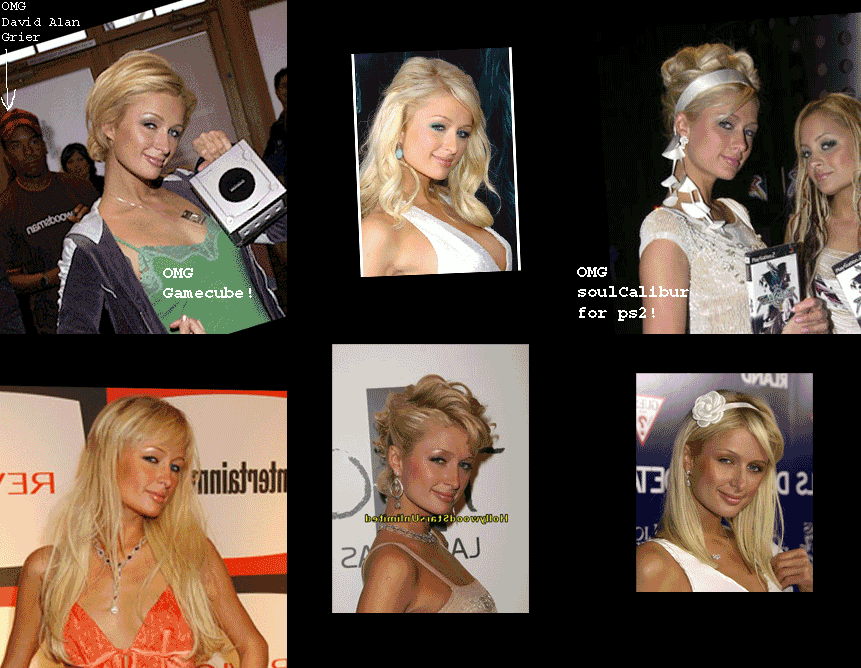
Saagim social club - urgent news:
Title 1 - "Who wears the sexiest underwear?"
Title 2 - "Why aren't the stars wearing underwear?"
Title 3 - "K.L found pink underpants from her desk"
20080218
The Course
Extracts from the task:
- "Perceived landscapes always consist of text, information, design, images etc., because they describe a relation between somebody and someplace."
- "...each given input by the literature you read is a landscape, in which You are looking for traces to show the ongoing changes…"
- "external input – what to collect? Landscapes in every way / Contemporary Landscape Architecture / Literature / Novels / Music / Fashion / Art and Design / Gender Issues / Popular Culture /"
Theme for our group: "Common landscape - common vs. high-brow. Does landscape serve as a mirror reflecting the everyday mass-culture we produce?"
***
The main question:
How to approach the task? How wide is the "mass-culture"? Every aspect of our life today OR mass-culture as pop/ hype/ trends / fashion / ways of thought / alternative lifestyle / TV / etc
***
http://popmaastik.blogspot.com
.
20071216


20071214

20071022


20071014


20071013

20071011


Subscribe to:
Posts (Atom)